
What makes a fashion sketch factory-ready (and why it matters more than you think)
There's a big difference between a sketch that looks good and a sketch that a factory can work from.
Most fashion founders start with the first. The ones who get clean first samples have the second.
Here's what separates them.
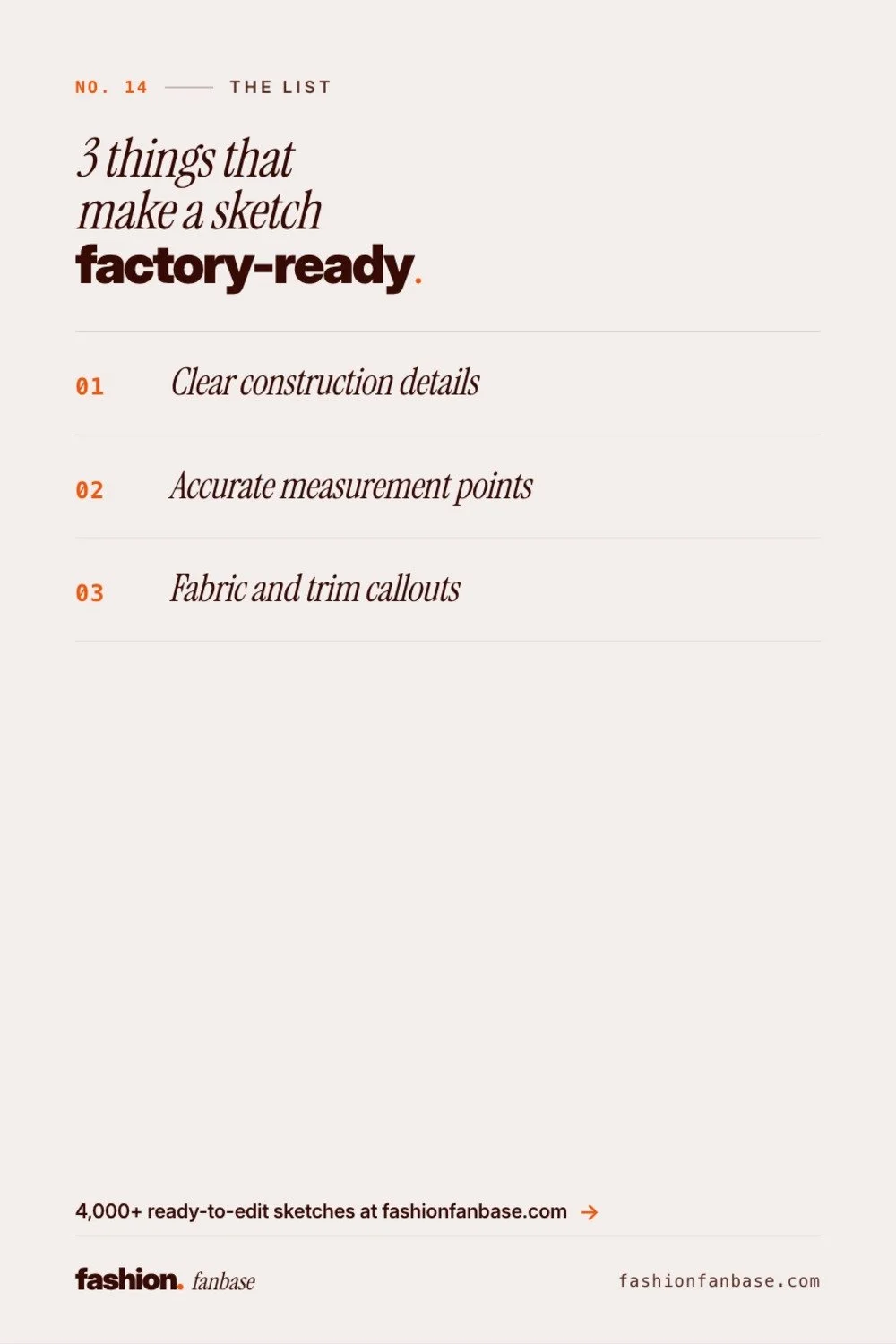
A factory-ready sketch is a technical document, not an illustration
The purpose of a flat sketch in a tech pack is not to look beautiful. It's to communicate every visible design detail of the garment to a manufacturer who has never seen your vision — and who needs to build it accurately from that document alone.
That means the sketch needs to show construction clearly: seam lines, panel breaks, topstitching, pocket placement, zip position, neckline shape, hem finish. Every detail that affects how the garment is made needs to be visible and unambiguous.
A fashion illustration — even a very good one — is not this. An illustration shows the idea. A flat sketch shows the instructions.
Clear construction details
Every seam, every panel, every topstitch line needs to be drawn accurately. If you have a centre front seam, it needs to show. If you have contrast binding on the neckline, it needs to show. If the back is different from the front, both views need to be included.
Factories make decisions based on what they can see. What they can't see, they'll interpret — and their interpretation is based on efficiency, not your design intent.
Accurate measurement points
A flat sketch without measurement callouts is incomplete. Factories need to know where each measurement is taken from — not just the number, but the exact point on the garment.
Standard measurement points exist for a reason. Using them means your factory, your pattern maker, and your QC team are all measuring the same thing in the same place.
Fabric and trim callouts
Every fabric in the garment — main body, lining, interlining, binding, trim — needs to be identified on the sketch. Every hardware piece, every label placement, every zip and button and elastic needs to be called out.
This is the information that prevents a factory from substituting something you didn't intend. If it's not called out, it's open to interpretation.
Where to start if you can't draw
This is where most first-time founders get stuck — they know what they want but they can't draw it with the precision a factory needs.
The Lightning Launch Vault includes 4,000+ editable flat sketches across every major category — womenswear, activewear, swimwear, childrenswear, and more. These are already drawn to the standard factories expect. You choose the closest base, edit the details to match your design, and you have a factory-ready sketch without needing to draw from scratch.
Pair that with our Tech Pack Templates and you have the complete document structure — sketch, measurements, fabric specs, construction notes — all in one place.